
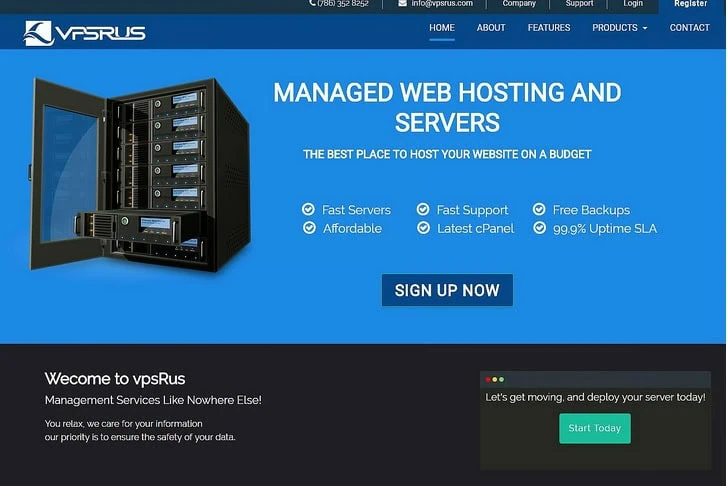
VPSRus is recognized in the web hosting industry for its initial focus on virtual private server (VPS) hosting solutions, targeting clients who desire robust control, scalability, and performance. Historically, VPSRus positioned itself as a competitive provider in the VPS hosting market, offering services that combined flexibility with server autonomy for developers, startups, and medium-sized businesses. The hallmark of VPSRus was to bridge the gap between shared hosting and dedicated servers, equipping clients with root access and customizable virtual environments for diverse deployment needs.
In recent years, however, VPSRus has shifted its service portfolio. Currently, the company no longer offers standard VPS hosting but instead emphasizes web hosting and managed dedicated server solutions. This pivot means that while the term “VPSRus” remains widely referenced in the context of VPS hosting, the company’s operational scope now leans toward classic web hosting and premium dedicated infrastructure offerings. This transition reflects broader market trends where cloud, hybrid, and managed solutions are increasingly in demand over traditional VPS hosting.
Despite this evolution, the company’s expertise in secure, high-performance environments remains integral to its hosting philosophy. Server resources, hardware configurations, and optimization technologies continue to support clients who require reliability and speed for business-critical websites and applications.
Core Features of VPSRus
Although VPSRus no longer supplies true VPS hosting, its suite of features for web hosting and dedicated servers deliver many core capabilities that once set its VPS offerings apart. The company emphasizes:
-
Dedicated Resource Allocation: Ensures that each hosting environment—be it web or dedicated server—is provisioned with guaranteed CPU, RAM, and storage resources, minimizing resource contention and bottlenecks for clients.
-
Custom Configurations: Clients have the flexibility to choose configurations that match their specific use case, including control panel options, operating system support (Linux/Windows), and software stack customization.
-
Robust Security: VPSRus employs industry-standard security protocols, DDoS protection, and regular patching to safeguard client data and uptime. Isolation between hosting instances reduces risks of cross-contamination in case of breaches.
-
Scalability and Migration Support: Managed migration tools and scalable plans allow clients to smoothly grow resources as their websites or applications expand in audience or complexity.
-
Technical Support: 24/7 professional support ensures rapid resolution of technical issues, which is crucial for businesses running mission-critical applications or high-traffic sites.
-
Data Center Reliability: VPSRus utilizes modern, geographically distributed data centers to deliver low-latency performance, redundancy, and high-availability infrastructure for its hosting environments.
While these features are now primarily offered through web hosting and dedicated server services, their origins in scalable VPS solutions highlight the company’s continued commitment to performance and customization.
Pricing
Pricing at VPSRus historically aligned with industry standards, offering competitive monthly and annual rates for its VPS and hosting services. Currently, the company provides pricing focused on web hosting and dedicated servers rather than VPS plans.
-
Web Hosting: Pricing tiers are designed to cater to individual websites, small businesses, and professionals—ranging from basic shared hosting plans to more robust managed solutions.
-
Dedicated Servers: Custom-quoted based on dedicated servers specifications, location, bandwidth requirements, and management preferences. Clients can tailor RAM, storage, CPU, and software stack for optimal cost-effectiveness.
For context, typical industry-wide VPS hosting pricing starts as low as $4–$5 per month for basic entry-level plans, scaling upward based on allocated resources, management options, and special features like automated backups or enhanced security. Although VPSRus does not currently advertise new VPS plans, its web hosting and dedicated hosting costs remain competitive within their respective service brackets.
Clients should note that service transitions and plan availability can affect not only pricing but also the technical composition and included features within each plan.
Technical Details
The technical infrastructure of VPSRus emphasizes enterprise-grade performance and stability:
-
Processor/CPU Options: Deployments utilize multicore Intel or AMD processors, supporting concurrent workloads and responsive website/application delivery.
-
Storage: Fast SSD (Solid State Drive) arrays are standard, enabling quick data retrieval, lower latency, and improved throughput for modern websites and high-traffic services.
-
Network Connectivity: Multi-gigabit uplinks, redundant fiber backbone connections, and DDoS protection ensure reliable service access with minimal interruptions.
-
Operating System Choices: Support for major Linux distributions and Windows Server options, empowering clients to align hosting with development and deployment workflows.
-
Isolation and Security: Even with the focus shifting from VPS to web/dedicated hosting, platform-level virtualization and hardware separation safeguard client environments.
-
Automated Backups and Disaster Recovery: Data protection protocols and snapshot features (if opted for) mean clients can quickly restore websites or applications in the event of accidental changes or outages.
The technical depth of VPSRus’s offerings makes the company well-suited for organizations prioritizing uptime, compliance, and high efficiency in their hosting operations.
Key Benefits of VPSRus VPS Hosting
-
Performance Reliability: Isolated hosting resources deliver consistent performance, ideal for business-critical applications.
-
Security: Strong account isolation and infrastructure-level protections reduce exposure to cyber threats.
-
Scalability: Flexible plans and easy migration paths support business growth and evolving hosting needs.
-
Customizability: Wide range of configuration options—OS, software, control panels—suit both developers and business users.
-
24/7 Support: Continuous technical assistance helps troubleshoot and resolve issues rapidly, reducing potential downtime.
Pros and Cons of VPSRus
Pros
-
Strong resource isolation for stability and security.
-
Customizable hosting environments accommodate diverse business and technical requirements.
-
Responsive support team available around the clock.
-
Reputable hardware and infrastructure underpin performance and dependability.
Cons
-
No longer offers VPS hosting, which may frustrate previous clients seeking to renew or upgrade VPS plans.
-
Reduced flexibility compared to multi-cloud or fully managed VPS platforms.
-
Limited transparency on current plan details; some features now only available through dedicated or web hosting services.
Top 10 Alternatives & Competitors to VPSRus
1. DigitalOcean
DigitalOcean is a major player in the VPS hosting space, famed for its developer-friendly interface, one-click application installs, and transparent billing. With global data centers and scalable resources, clients can start with a simple droplet and scale up effortlessly. DigitalOcean’s competitive pricing, extensive community tutorials, and robust documentation appeal to startups and developers alike. Plans begin at $4/month, delivering SSD storage, flexible OS options, and strong uptime guarantees. Although resource-heavy businesses might need to look at higher-tier plans, DigitalOcean remains a preferred choice for those seeking ease of use, clarity in costs, and a strong technical backbone.
2. Hostinger
Hostinger stands out for its affordable VPS hosting plans, starting at $4.99/month. It employs NVMe SSD storage for speed, AMD EPYC processors, and a dedicated public API for automation and integration. Users enjoy full root access, Linux/Windows OS choices, scalable resources, and free snapshots/backups. Hostinger’s blend of performance, customer support, and cost-effectiveness make it appealing to small businesses and developers who require flexibility and reliability without overspending. The platform has a strong reputation for uptime and customer satisfaction.
3. Vultr
Vultr attracts clients who value global reach—with over 20 data center locations—and straightforward hourly or monthly pricing. The platform provides instant deployment, dedicated bare metal and virtual instances, and powerful NVMe SSD storage. Vultr’s self-service controls, flexible plans, and developer-centric features help businesses scale apps easily while maintaining budget discipline. Rates start at $2.50/month, and the platform’s strong API and automation capabilities give it an edge among technically savvy clients.
4. Linode (Akamai)
Now operated by Akamai, Linode maintains its reputation for simple flat-rate VPS pricing and high-performance cloud servers. Linode is popular for its friendly interface, excellent documentation, and strong customer support. Plans start at $5/month, including SSD storage, DDoS protection, and a variety of developer tools for server automation and monitoring. Designed for cost-conscious businesses, freelancers, and developers, Linode also offers managed storage and backup services, making it a powerful alternative for those leaving VPSRus.
5. ScalaHosting
ScalaHosting merges managed cloud VPS and traditional hosting to provide versatility for diverse user needs. Their value proposition includes SPanel (a cPanel alternative), automated security tools like SShield, and managed WordPress options. ScalaHosting’s pricing is competitive, with entry-level cloud VPS plans supporting guaranteed resources and free daily backups. The provider is best suited for small and medium-sized businesses wanting scalability and enhanced security, plus ease of use through an intuitive dashboard.
6. Hostwinds
Hostwinds offers robust VPS hosting in both managed and unmanaged formats. Their platform is designed for maximum control, featuring full root access, SSD storage, and nightly backups. Hostwinds supports a range of operating systems and control panels, catering to both individual developers and larger enterprises with specific compliance needs. Their customer support is frequently highlighted for responsiveness, and plans can be customized for different levels of performance and redundancy.
7. Cloudways
Cloudways stands out as a managed hosting platform that simplifies cloud VPS management by acting as an intermediary layer between popular IaaS hosts (DigitalOcean, Linode, Vultr, AWS, Google Cloud) and the end-user. Clients benefit from one-click app deployments, automated updates, real-time monitoring, and optimized caching—all without complex server management. Cloudways offers competitive pay-as-you-go pricing and is popular with agencies, ecommerce sites, and growing startups seeking simplicity plus scalability.
8. OVHcloud
OVHcloud offers scalable VPS hosting leveraging the latest AMD and Intel server technologies. The provider focuses on scalability, anti-DDoS protection, and comprehensive backup solutions. OVHcloud’s VPS plans include unlimited bandwidth (up to 2 Gbps), a choice of operating systems, admin access, and a global data center presence. The platform is ideal for users needing flexible resource allocation, reliability, and transparency in pricing.
9. 1Gbits
1Gbits delivers KVM-based VPS hosting with high resource isolation, full root access, SSD storage, and immediate server deployment. Flexible billing (hourly/monthly), top-tier uptime SLA, and responsive 24/7 support position 1Gbits as a strong option for SMEs and agencies seeking control without the premium pricing. Customizable plans support both Linux and Windows operating systems, and the service is designed to empower users seeking straightforward, reliable infrastructure.
10. Contabo
Contabo is known for its value-driven VPS plans, providing a high resource-to-cost ratio. Plans start at under $5/month, offering high RAM allocations, automated backup options, and flexible upgrades. Contabo appeals to budget-conscious projects that still require significant computing resources, security features, and fast support response. Their straightforward pricing and focus on transparency are attractive to startups and developers scaling on a tight budget.
Scalability: Flexible Resource Management in VPS Hosting
Scalability is a defining feature of modern VPS hosting solutions—including those leveraging NVMe SSD technology—which empowers users to seamlessly adjust their allocated resources as their needs change. This flexibility extends to key areas such as CPU cores, RAM, storage capacity (especially high-speed NVMe SSDs), and network bandwidth.
Key Points on Scalability
-
CPU Cores: Users can increase or decrease the number of CPU cores assigned to their virtual environment, ensuring adequate processing power for changing workloads.
-
RAM: Memory allocation can be quickly adjusted. Upgrading provides better performance for applications experiencing growth, while downgrading helps optimize costs for lighter workloads.
-
NVMe SSD Storage: Storage upgrades utilize ultrafast NVMe SSDs, offering significant improvements in data transfer speed, low latency, and IOPS. As demands grow, additional NVMe storage can be provisioned with minimal impact on server uptime.
-
Bandwidth: Network throughput (measured in Mbps or Gbps) can be scaled up to accommodate higher traffic or intensive tasks and reduced if usage patterns decrease.
Upgrade and Downgrade Process
Most VPS platforms allow users to initiate scaling actions directly through a control panel:
-
Upgrades (CPU, RAM, Storage, Bandwidth) are usually available with little to no downtime, often applied in real-time after confirmation and payment. This means businesses can quickly respond to demand spikes or operational changes without service interruption.
-
Downgrades are also supported, though some providers may require a brief maintenance window to resize resources safely. Some environments may provision a new instance to prevent data loss or conflicts.
Additional Advantages
-
Cost Efficiency: Scale resources only when needed, optimizing operating expenses.
-
No Vendor Lock-In: Ability to migrate up or down between plans ensures flexibility for startups and growing enterprises alike.
-
Performance Guarantee: Dedicated resources (CPU, RAM, NVMe SSDs) ensure consistent performance even as workloads scale.
Real-World Example
Providers like those offering NVMe VPS plans highlight the ability to:
-
Adjust CPU, RAM, or disk space instantly from a management portal
-
Scale storage with fast NVMe drives for superior performance
-
Modify bandwidth without throttling risks or hidden fees
This approach accommodates evolving business processes, application growth, and varying seasonal loads without requiring users to migrate to new hardware or endure lengthy provisioning times.
Scalable VPS hosting with NVMe SSDs supports business agility and efficiency, providing fast, seamless upgrades and downgrades for all essential server resources.
Conclusion
VPSRus has carved a niche for itself by delivering reliable hosting solutions focused on security, customization, and technical support. While it no longer offers traditional VPS hosting, its commitment to robust infrastructure persists through premium web hosting and dedicated servers. For businesses and individuals still seeking VPS hosting under the “VPSRus” model, leading alternatives like DigitalOcean, Hostinger, Vultr, and others provide a comprehensive ecosystem of features, flexible configurations, and pricing options to suit a wide range of needs. When selecting a new VPS hosting provider, assess your requirements for performance, scalability, and support to find the platform that aligns best with your project’s goals and growth trajectory.